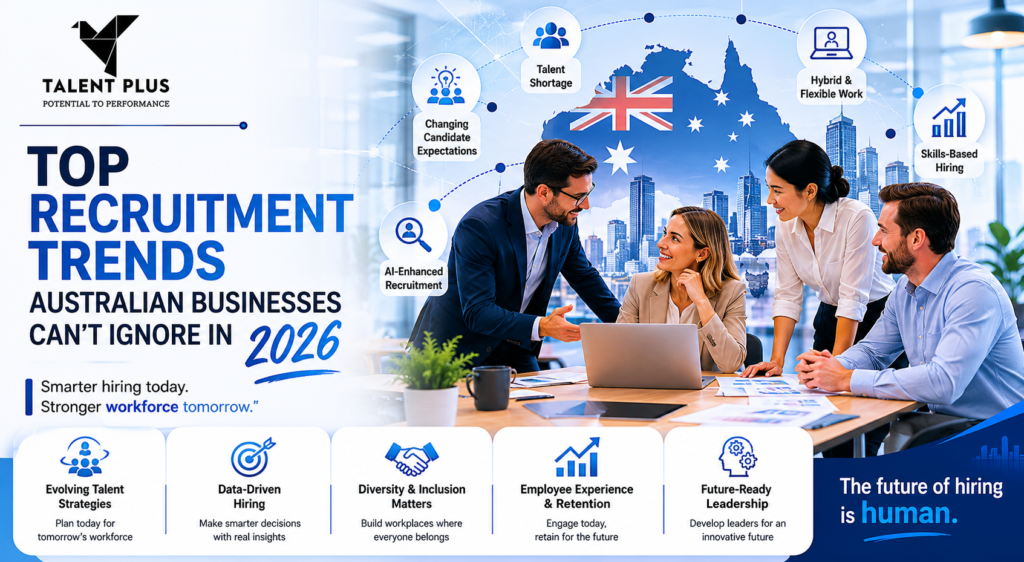
The Australian workforce is evolving faster than ever in 2026. Businesses across industries are facing major shifts in hiring expectations, workforce planning, and employee retention strategies. From AI-powered recruitment tools to skills-based hiring, companies are rethinking how they attract and retain top talent in an increasingly competitive market.
As organisations continue adapting to economic changes and workforce demands, staying ahead of recruitment trends is no longer optional. Businesses that fail to modernise their hiring approach risk losing skilled professionals to competitors offering flexibility, growth opportunities, and better workplace culture.
At Talent Plus 360, we help Australian businesses stay prepared for the future of recruitment with innovative staffing solutions, workforce strategies, and talent acquisition services designed for long-term success. Because apparently finding good employees before your competitors do has become a survival sport now.
1. Skills-Based Hiring Is Becoming the New Standard
Australian employers are shifting away from traditional degree-focused recruitment and placing more value on practical skills and real-world experience. Companies now prioritise candidates who can immediately contribute to business goals instead of relying only on academic qualifications.
This trend is especially strong in industries like IT, healthcare, construction, logistics, and digital marketing. Employers are using skill assessments, certifications, and project portfolios to identify capable professionals who can adapt quickly to changing business needs.
Skills-based hiring also opens opportunities for a more diverse workforce. Businesses gain access to talented candidates who may not have formal degrees but possess valuable expertise and hands-on industry knowledge. Humanity finally discovering that a framed certificate does not automatically create competence. Historic moment.
2. AI-Powered Recruitment Is Reshaping Hiring Processes
Artificial Intelligence is transforming recruitment across Australia in 2026. Businesses are increasingly using AI tools to screen resumes, automate candidate communication, and improve hiring efficiency. These technologies reduce manual work and help recruiters identify suitable applicants faster.
AI-driven recruitment platforms can analyse candidate profiles, predict job compatibility, and improve hiring accuracy. This allows businesses to streamline recruitment processes while reducing time-to-hire and operational costs.
However, companies must balance automation with human interaction. Candidates still value personal communication, transparency, and authentic engagement throughout the recruitment process. Technology may speed up hiring, but people still prefer speaking to humans occasionally. Disturbing but true.
3. Employee Retention Is Now a Top Business Priority
Recruitment in 2026 is no longer just about attracting talent. Australian businesses are investing heavily in employee retention strategies to reduce turnover and maintain workforce stability. Retaining skilled employees has become more cost-effective than constantly replacing them.
Employees today expect more than competitive salaries. They seek career development, flexible working arrangements, mental health support, and positive workplace culture. Businesses that fail to provide these benefits often struggle with long-term employee commitment.
Forward-thinking companies are creating employee-focused environments that encourage growth, collaboration, and work-life balance. This approach helps organisations build stronger teams and improve overall productivity. Revolutionary concept: treating employees well makes them stay. Economists everywhere stunned.
4. Flexible and Hybrid Work Models Continue to Grow
Hybrid work remains one of the biggest recruitment trends in Australia. Employees increasingly prefer flexible work arrangements that allow them to balance professional responsibilities with personal commitments. Businesses offering hybrid options often attract higher-quality candidates.
Companies are redesigning workplace policies to support remote collaboration, digital communication, and flexible scheduling. This shift is helping organisations improve employee satisfaction while reducing workplace burnout.
In competitive industries, flexibility has become a key deciding factor for job seekers. Employers who refuse to adapt may struggle to attract modern professionals seeking better work-life integration. Turns out people enjoy not spending three hours trapped in traffic contemplating existence. Fascinating discovery.
5. Employer Branding Is Influencing Recruitment Success
In 2026, employer branding plays a major role in attracting top talent. Candidates now research company culture, employee reviews, leadership values, and workplace reputation before applying for jobs. Businesses with strong employer brands gain a significant competitive advantage.
Companies are investing in social media presence, employee testimonials, and transparent communication to build trust with potential candidates. A positive employer image helps organisations attract skilled professionals who align with their business values.
At Talent Plus 360, we understand the importance of employer branding in today’s recruitment market. We help businesses strengthen their hiring strategies while connecting them with talented professionals who fit their long-term goals.
6. Diversity and Inclusion Are Driving Workforce Growth
Australian businesses are increasingly focusing on diversity and inclusion to create stronger and more innovative teams. Companies recognise that diverse workplaces encourage creativity, collaboration, and broader problem-solving perspectives.
Recruitment strategies are now designed to remove hiring bias and create equal opportunities for candidates from different backgrounds. Inclusive hiring practices help businesses build healthier workplace cultures and improve employee engagement.
Organisations that prioritise diversity also strengthen their employer reputation and attract candidates who value fairness, representation, and workplace equality. Society slowly realising that hiring the same personality clone repeatedly may not be peak innovation. Remarkable progress.
7. Data-Driven Recruitment Is Improving Hiring Decisions
Data analytics is becoming a critical part of recruitment in 2026. Businesses are using recruitment metrics to evaluate hiring performance, candidate quality, employee retention, and workforce trends. This allows companies to make smarter and more strategic hiring decisions.
Recruiters can now track candidate engagement, monitor hiring efficiency, and identify gaps in recruitment processes using real-time insights. Data-driven strategies help businesses reduce hiring risks while improving workforce planning.
Companies that embrace recruitment analytics gain better visibility into market trends and employee expectations. This creates a more efficient hiring process that supports long-term business growth and workforce stability.
Why Australian Businesses Need Modern Recruitment Strategies
The recruitment landscape in Australia is evolving rapidly, and businesses must adapt to remain competitive in 2026. Companies that embrace innovation, employee-focused culture, and modern hiring strategies will be better positioned to attract and retain top talent.
From AI recruitment tools to flexible work models, today’s workforce expects businesses to provide more personalised and future-focused employment experiences. Organisations that ignore these changes risk falling behind in an increasingly competitive hiring market.
At Talent Plus 360, we help Australian businesses navigate modern recruitment challenges with customised staffing solutions, talent acquisition strategies, and workforce support tailored to today’s evolving employment landscape. Because recruitment in 2026 is no longer about filling positions. It is about building teams that can actually survive the chaos ahead.