
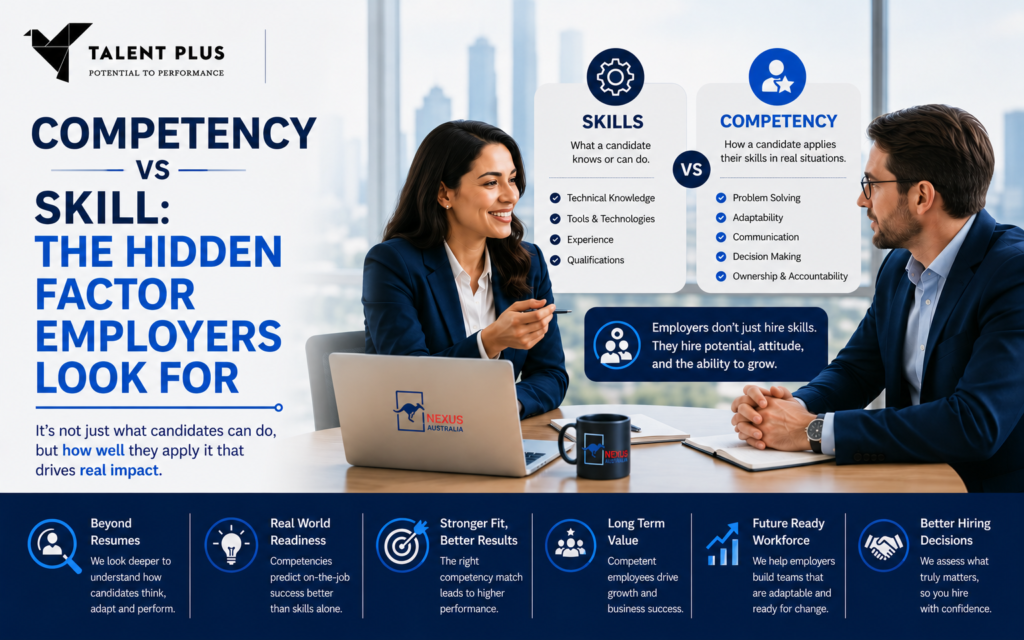
The modern hiring landscape has evolved significantly over the last decade. Employers are no longer focused solely on qualifications, certifications, and technical expertise. While these elements remain important, organizations are increasingly looking beyond resumes to identify candidates who can deliver consistent performance and contribute to long-term business success.
This shift has brought greater attention to an often misunderstood concept: competency. Many professionals use the terms competency and skill interchangeably, but they are not the same thing. Understanding the difference can help job seekers position themselves more effectively and help employers make smarter hiring decisions.
Today, companies across industries are placing greater emphasis on competency-based recruitment because it provides a clearer picture of how an individual will perform in the workplace.
At Talent Plus 360, we help businesses identify talent beyond resumes by focusing on competencies that drive performance, productivity, and organizational growth.
Understanding the Difference Between Skills and Competencies
Before exploring why employers value competencies so highly, it is important to understand the distinction between these two concepts.
A skill refers to a specific learned ability that allows an individual to perform a task effectively. Skills are often measurable, teachable, and easy to identify during training or education.
Examples of skills include coding, accounting, operating machinery, data analysis, graphic design, project management, and customer service.
Competency, on the other hand, goes beyond technical ability. It combines knowledge, skills, behavior, attitude, and personal attributes that enable someone to perform successfully in real workplace situations.
This means that while a person may possess a skill, they may not necessarily demonstrate the competency required to apply that skill effectively under different circumstances.
Why Employers Focus on Competencies
Employers invest significant time and resources into recruitment. They want to ensure candidates can not only perform tasks but also contribute positively to workplace culture, team dynamics, and business objectives.
Skills may help candidates secure interviews, but competencies often determine who gets hired and promoted.
Organizations have discovered that employees with strong competencies tend to adapt faster, collaborate better, solve problems more effectively, and perform consistently under pressure.
As a result, competency-based hiring has become a preferred strategy for businesses seeking sustainable workforce success.
What Is a Skill?
A skill is generally a practical ability acquired through education, training, experience, or practice.
Skills can often be measured through certifications, qualifications, examinations, or practical assessments.
For example, a software developer may possess programming skills, an accountant may have financial reporting skills, and a marketer may have content creation skills.
These abilities help individuals perform specific tasks required within their roles.
However, possessing a skill does not automatically guarantee success in a professional environment.
What Is a Competency?
A competency is a broader concept that combines technical knowledge with behavioral characteristics and workplace effectiveness.
Competencies reflect how individuals apply their skills while interacting with colleagues, customers, managers, and workplace challenges.
Examples of competencies include leadership, communication, adaptability, critical thinking, decision-making, teamwork, accountability, and emotional intelligence.
These qualities often influence long-term performance far more than technical skills alone.
A Real-World Example
Imagine two candidates applying for the same project management position.
Both candidates possess the technical skills required to manage schedules, budgets, and project documentation. Their qualifications appear almost identical on paper.
However, one candidate demonstrates stronger communication, leadership, problem-solving, and stakeholder management abilities.
Although both applicants have similar skills, the second candidate shows greater competency and is more likely to succeed in the role.
This is why employers increasingly evaluate competencies during recruitment processes.
Competencies Drive Workplace Performance
Businesses operate in dynamic environments where challenges arise regularly.
Employees are expected to solve problems, manage priorities, communicate effectively, and collaborate with diverse teams.
These expectations require competencies rather than just technical expertise.
An employee with excellent skills but poor communication may struggle to work effectively within a team.
Conversely, an employee with strong competencies can often learn new skills more quickly and adapt to changing workplace demands.
The Growing Importance of Soft Competencies
Soft competencies have become essential in modern workplaces.
Organizations value qualities such as resilience, adaptability, emotional intelligence, and collaboration because they directly influence workplace productivity.
Technology continues to change rapidly, meaning technical skills can become outdated over time.
Competencies, however, remain highly transferable across industries and roles.
This makes competency development a long-term investment for both individuals and organizations.
Why Competencies Matter More in Leadership Roles
As professionals progress into management and leadership positions, competencies become increasingly important.
Leaders are expected to motivate teams, manage conflict, make strategic decisions, and drive organizational growth.
These responsibilities require strong behavioral competencies rather than technical skills alone.
A technically brilliant employee may struggle as a manager if they lack communication, coaching, or leadership competencies.
This is one reason why many organizations assess leadership potential through competency frameworks.
Common Competencies Employers Look For
Although competency requirements vary by industry and role, several competencies consistently appear in recruitment assessments.
Communication is one of the most sought-after competencies because effective communication influences teamwork, productivity, and customer relationships.
Adaptability is another critical competency as organizations face constant technological, economic, and operational changes.
Problem-solving, accountability, teamwork, initiative, resilience, and leadership are also highly valued across industries.
These competencies help employees contribute beyond their immediate job responsibilities.
Competency-Based Recruitment Explained
Competency-based recruitment focuses on evaluating how candidates have demonstrated specific behaviors and capabilities in past situations.
Rather than asking only technical questions, employers often explore real-world examples of workplace experiences.
Interview questions may focus on situations involving conflict resolution, teamwork, decision-making, leadership, or customer service.
This approach provides deeper insight into how candidates are likely to perform in future roles.
How Candidates Can Demonstrate Competencies
Job seekers should not focus exclusively on listing technical skills on their resumes.
Employers also want evidence of workplace behaviors and achievements that demonstrate competencies.
Candidates should highlight examples where they solved problems, led projects, improved processes, managed challenges, or collaborated successfully with teams.
Using measurable achievements strengthens credibility and showcases practical competency application.
Developing Competencies for Career Growth
Unlike many people assume, competencies can be developed and strengthened over time.
Professional development programs, mentorship, workplace experiences, leadership opportunities, and continuous learning all contribute to competency growth.
Seeking feedback from managers and colleagues can also help individuals identify areas for improvement.
Investing in competency development often leads to stronger career progression and greater professional opportunities.
How Competencies Benefit Organizations
Hiring competency-driven employees provides significant benefits for organizations.
These individuals often adapt more quickly, require less supervision, and contribute positively to workplace culture.
Strong competencies also improve employee engagement, productivity, customer satisfaction, and retention rates.
Organizations that prioritize competencies during recruitment often build stronger and more resilient teams.
This creates long-term advantages in increasingly competitive business environments.
The Future of Hiring Is Competency-Based
As industries continue evolving, employers are becoming less focused on traditional qualifications alone.
Businesses increasingly recognize that successful employees combine technical expertise with strong behavioral competencies.
The future workforce will require professionals who can adapt, communicate, innovate, and collaborate effectively.
Competency-based hiring helps organizations identify these high-potential individuals more accurately.
This trend is expected to become even more prominent across global recruitment markets.
Why Choose Talent Plus 360?
At Talent Plus 360, we understand that successful recruitment goes beyond matching qualifications with job descriptions.
Our recruitment approach focuses on identifying candidates who possess both the technical skills and the competencies required for long-term success.
We help businesses build stronger teams through competency-based hiring strategies designed to improve performance and workforce quality.
Whether you are an employer seeking exceptional talent or a professional looking to advance your career, Talent Plus 360 provides trusted recruitment solutions tailored to modern workforce needs.
Final Thoughts
Skills may help individuals perform tasks, but competencies determine how effectively those tasks are executed in real workplace situations.
This distinction is becoming increasingly important as organizations seek adaptable, collaborative, and high-performing professionals.
Employers understand that technical skills can often be taught, while strong competencies frequently drive long-term success and organizational impact.
Visit Talent Plus 360 today to discover how competency-based recruitment can help businesses hire smarter and professionals build stronger careers.