
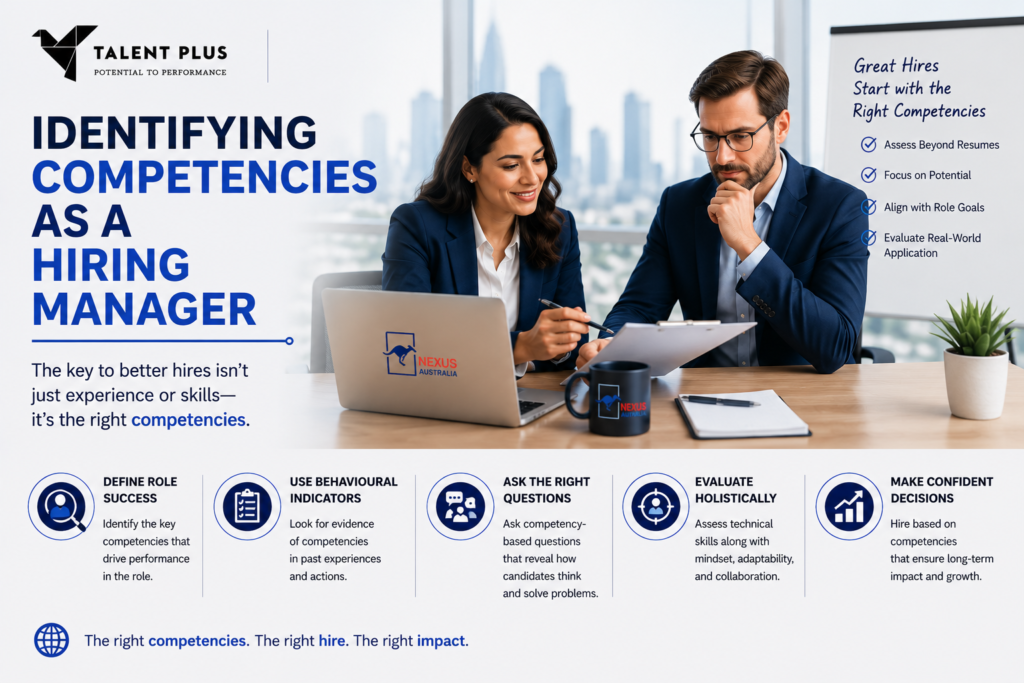
In today’s competitive recruitment landscape, hiring decisions have become more complex than simply matching qualifications to a job description. Organizations are looking beyond technical expertise and educational achievements to find individuals who can contribute meaningfully to business growth and workplace culture.
As industries evolve and workplace expectations change, employers increasingly recognize that skills alone do not guarantee success. Two candidates may possess identical qualifications, yet one consistently outperforms the other because of stronger competencies.
For hiring managers, identifying competencies has become one of the most important aspects of successful recruitment. Understanding how to evaluate competencies can lead to better hiring outcomes, stronger teams, and improved employee retention.
At Talent Plus 360, we help Australian businesses identify high-performing candidates through competency-focused recruitment strategies designed to support long-term workforce success.
What Are Competencies?
Competencies are the combination of knowledge, skills, behaviors, attitudes, and personal attributes that enable an individual to perform effectively in a particular role.
Unlike technical skills, which focus on specific tasks, competencies reflect how a person applies those skills in real workplace situations.
Examples of competencies include communication, leadership, adaptability, problem-solving, accountability, teamwork, resilience, and emotional intelligence.
These qualities often determine how successfully an employee performs within an organization over time.
Why Competencies Matter More Than Ever
The modern workplace is changing rapidly. Technology evolves constantly, industries face new challenges, and organizations must adapt to shifting market demands.
As a result, employers increasingly need individuals who can learn quickly, solve problems, and work effectively within diverse teams.
Technical skills can often be taught through training programs. Competencies, however, influence how individuals respond to challenges, manage responsibilities, and contribute to workplace culture.
This makes competency assessment a critical component of effective hiring decisions.
Skills vs Competencies
Many hiring managers mistakenly focus heavily on technical qualifications while overlooking competencies.
Skills represent the ability to perform specific tasks such as coding, accounting, operating machinery, or managing software systems.
Competencies go deeper by evaluating how individuals apply those skills while interacting with colleagues, customers, and workplace challenges.
Understanding this distinction helps hiring managers identify candidates who are likely to thrive beyond the technical requirements of the role.
The Cost of Hiring Based on Skills Alone
Hiring decisions based solely on technical ability can sometimes lead to costly mistakes.
A candidate may possess excellent technical expertise but struggle with teamwork, communication, adaptability, or workplace relationships.
These issues can impact productivity, employee morale, and overall business performance.
By identifying competencies during recruitment, hiring managers can reduce the risk of poor hiring decisions and improve long-term retention.
Start with a Competency Framework
One of the most effective ways to identify competencies is by developing a competency framework for each role.
A competency framework outlines the key behaviors, attributes, and capabilities required for success within a position.
This framework helps create consistency throughout the recruitment process and ensures all candidates are assessed against the same criteria.
It also provides a clearer understanding of what success looks like within a specific role.
Define Core Competencies
Every organization should identify core competencies that align with its values, culture, and business objectives.
These competencies often apply across multiple departments and job functions.
Examples include communication, accountability, customer focus, collaboration, adaptability, and integrity.
Evaluating these competencies helps ensure candidates align with both the role and the organization as a whole.
Identify Role-Specific Competencies
While core competencies are important, each position also requires role-specific competencies.
For example, leadership roles may require strategic thinking, decision-making, and people management capabilities.
Customer-facing positions may prioritize communication, empathy, and conflict resolution.
Technical roles may require analytical thinking, attention to detail, and problem-solving abilities.
Clearly identifying these requirements improves hiring accuracy significantly.
Use Competency-Based Interview Questions
Competency-based interviews are among the most effective tools for assessing candidates.
Rather than focusing only on qualifications, these interviews encourage candidates to share examples of past workplace experiences.
Questions often begin with phrases such as “Tell me about a time when…” or “Describe a situation where…”
These responses provide valuable insight into how candidates behave and perform in real-world scenarios.
Apply the STAR Method
The STAR method is a powerful framework for evaluating competency-based interview responses.
STAR stands for Situation, Task, Action, and Result.
This approach helps candidates explain experiences in a structured way while giving hiring managers a clearer understanding of their decision-making process.
Responses that demonstrate measurable outcomes often provide stronger evidence of competency.
Assess Communication Skills Carefully
Communication remains one of the most sought-after competencies across industries.
Hiring managers should evaluate not only what candidates say but also how they communicate.
Clarity, professionalism, active listening, and confidence often indicate strong communication capabilities.
These qualities influence collaboration, leadership potential, and customer interactions within the workplace.
Evaluate Problem-Solving Ability
Problem-solving competency reveals how candidates approach challenges and make decisions under pressure.
Hiring managers should explore situations where candidates faced obstacles, managed unexpected issues, or implemented solutions.
Strong problem-solvers typically demonstrate critical thinking, creativity, and a proactive mindset.
These qualities are valuable in almost every professional environment.
Look for Adaptability
Modern workplaces are constantly evolving, making adaptability a highly desirable competency.
Candidates who can adjust to change quickly often perform better during organizational transitions and business growth periods.
Interview questions focusing on change management experiences can reveal adaptability levels effectively.
Flexible employees are generally better equipped to handle future workplace challenges.
Observe Emotional Intelligence
Emotional intelligence is increasingly recognized as a critical workplace competency.
This quality influences how individuals manage emotions, build relationships, and navigate interpersonal situations.
Employees with strong emotional intelligence often communicate more effectively and contribute positively to workplace culture.
Hiring managers should pay close attention to self-awareness, empathy, and relationship-building behaviors during interviews.
Assess Teamwork and Collaboration
Most roles require some level of teamwork and cross-functional collaboration.
Candidates should demonstrate their ability to work effectively with colleagues from diverse backgrounds and departments.
Examples involving successful projects, conflict resolution, and collaborative achievements often reveal valuable insights.
Strong team players contribute significantly to organizational success.
Avoid Common Hiring Biases
Identifying competencies requires objective evaluation rather than personal preference.
Hiring managers should avoid making decisions based solely on first impressions, educational backgrounds, or personality similarities.
Structured interviews and competency frameworks help reduce unconscious bias during recruitment.
Objective assessment methods improve hiring quality and diversity outcomes.
Use Multiple Assessment Methods
Competencies should not be evaluated through interviews alone.
Skills assessments, behavioral assessments, role-play exercises, and reference checks can provide additional perspectives.
Combining multiple assessment methods creates a more complete picture of each candidate’s capabilities.
This approach improves confidence in final hiring decisions.
The Role of Reference Checks
Reference checks remain a valuable tool for validating competencies.
Former managers and colleagues can often provide useful insights regarding communication, leadership, teamwork, and workplace behavior.
Asking competency-focused questions during reference checks can strengthen the overall evaluation process.
This additional verification helps reduce recruitment risks.
Building High-Performing Teams Through Competencies
Organizations that prioritize competencies during recruitment often build stronger and more resilient teams.
Employees with the right competencies tend to adapt faster, collaborate more effectively, and contribute positively to workplace culture.
These individuals are also more likely to grow within the organization and support long-term business goals.
Competency-based hiring creates a foundation for sustainable workforce success.
Why Talent Plus 360 Focuses on Competency-Based Recruitment
At Talent Plus 360, we understand that successful hiring goes beyond matching resumes with job descriptions.
Our recruitment approach helps Australian businesses identify candidates who possess both the technical expertise and behavioral competencies required for long-term success.
We work closely with employers to understand role requirements, assess competencies, and deliver high-quality talent solutions.
Our goal is to help organizations build stronger teams that drive productivity, innovation, and business growth.
Final Thoughts
Identifying competencies is one of the most valuable skills a hiring manager can develop in today’s competitive recruitment environment.
While technical skills remain important, competencies often determine whether a candidate will succeed, adapt, and contribute meaningfully within an organization.
By focusing on communication, adaptability, leadership, problem-solving, emotional intelligence, and teamwork, hiring managers can make more informed recruitment decisions.
Visit Talent Plus 360 today to discover how competency-based recruitment can help your business attract, hire, and retain exceptional talent for long-term success.