
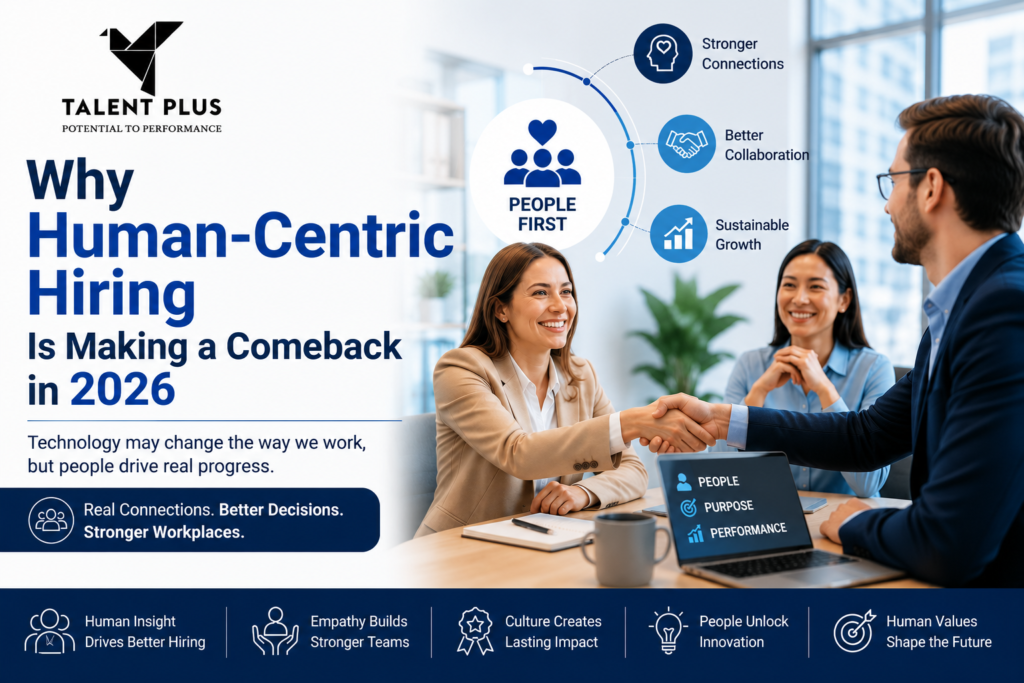
In a world increasingly driven by automation and algorithmic decision-making, something quietly powerful is happening across the recruitment landscape. Companies are choosing to put people back at the center of their hiring process. Human-centric hiring is no longer just a feel-good philosophy — in 2026, it has become one of the smartest talent strategies a business can adopt.
At Talent Plus 360, we have seen this shift accelerating across industries of all sizes. Organizations that once leaned heavily on AI screening tools and keyword filters are now redesigning their entire recruitment experience around empathy, transparency, and genuine human connection.
What Is Human-Centric Hiring?
Human-centric hiring is a recruitment approach that evaluates candidates as whole people — their values, mindset, emotional intelligence, and potential — rather than measuring them purely against a rigid list of qualifications. It moves the conversation away from “Does this resume tick every box?” toward “Does this person have what it takes to grow, contribute, and thrive here?”
This approach does not abandon structure or fairness. It redefines what fairness actually looks like in a modern hiring process. Instead of uniformity, it pursues genuine equity — creating space for diverse backgrounds, non-linear careers, and unconventional talent to be seen and valued.
Human-centric hiring also places accountability on the employer. It asks companies to examine their own processes for hidden barriers, communicate honestly with every candidate, and treat applicants with respect regardless of the final outcome.
Why the Pendulum Is Swinging Back
For nearly a decade, the recruitment industry placed enormous faith in technology. Automated screening systems, behavior-prediction tools, and algorithmic shortlisting promised to eliminate bias and accelerate hiring cycles. But the results told a more complicated story. Many of these tools replicated historical biases, filtered out high-potential candidates from non-traditional backgrounds, and created an experience so cold and impersonal that top talent simply walked away.
At the same time, the workforce itself transformed. Post-pandemic professionals and Gen Z job seekers entering the market in 2026 carry very different expectations than previous generations. They research employers before applying, treat the hiring process as a preview of company culture, and disengage quickly from any experience that feels transactional or disrespectful of their time.
With talent shortages intensifying across technology, healthcare, and sustainability sectors, companies could no longer afford the luxury of a broken candidate experience. The business case for treating people like people became impossible to ignore — and that is precisely what is driving the comeback of human-centric hiring in 2026.
The Five Pillars of Human-Centric Hiring in 2026
The organizations leading this shift are not simply softening the tone of their job descriptions. They are rebuilding their hiring architecture around five core principles that place the human experience front and center.
1. Empathy-Led Communication Every touchpoint in the recruitment journey — from the first job posting to the final decision — is crafted with the candidate’s emotions in mind. Rejection messages are timely, specific, and respectful. Candidates never feel like they disappeared into a black hole after applying.
2. Potential Over Pedigree Hiring managers are trained to look beyond prestigious university names and linear career paths. Curiosity, coachability, adaptability, and growth mindset are weighted as heavily as technical qualifications during the evaluation process.
3. Structured Equity Interviews follow consistent question frameworks and scoring rubrics to reduce personal bias. At the same time, room is created for candidates to bring their authentic selves to the conversation rather than performing a scripted version of what they think the interviewer wants to hear.
4. Radical Transparency Salary ranges, team dynamics, role expectations, and even known organizational challenges are shared openly with candidates. This level of honesty builds trust before day one and dramatically reduces early attrition caused by unmet expectations.
5. Collaborative Decision-Making Single-person hiring decisions are replaced by diverse interview panels where trained evaluators bring different perspectives to the table. This reduces groupthink, surfaces blind spots, and leads to more confident, well-rounded hiring outcomes.
The Role of Technology in a Human-First Process
Human-centric hiring does not mean abandoning technology — it means deploying it more intelligently. In 2026, the smartest companies are using automation to handle the logistical weight of recruiting so that their teams can invest more energy in genuine human interaction. Scheduling tools, targeted job board algorithms, and initial assessments handle the heavy lifting, while recruiters focus on conversations that matter.
The best recruitment technology today is built to surface context, not eliminate candidates. Platforms that allow video introductions alongside written applications, tools that flag potential rather than filter by keyword alone, and diversity analytics dashboards that track equity at every stage of the funnel — these are the technologies earning their place in human-centric hiring stacks.
At Talent Plus 360, our philosophy has always been that technology should serve the recruiter’s instincts, not replace them. We combine intelligent sourcing capabilities with deeply personal candidate engagement to help organizations find the right people — not just the most keyword-optimized ones.
How Candidate Experience Drives Real Business Results
There is a direct and measurable link between how candidates are treated during hiring and how a company performs in the talent market over time. Candidates who feel respected — even those who do not receive an offer — become quiet ambassadors for your employer brand. They refer friends, leave positive reviews on platforms like Glassdoor, and often reapply when future opportunities arise.
Those who feel dismissed, ignored, or dehumanized do the opposite — and they do it loudly, in an era where a single social media post can reshape how thousands of potential applicants perceive your brand overnight. Reputation in recruitment is built or eroded one candidate interaction at a time, and companies in 2026 are acutely aware of this reality.
The quality of actual hires also improves significantly when processes are human-centered. When candidates feel psychologically safe during interviews, hiring managers receive a far more accurate picture of who they are really bringing on board. There are fewer surprises in the first 90 days, onboarding feels like a continuation of a relationship already established, and new employees arrive with trust already banked — which accelerates their performance and integration into the team.
What This Means for Your Hiring Strategy Today
If your organization still relies primarily on automated screening and keyword filtering to identify talent, 2026 is the year to seriously reconsider that approach. The candidates you most want to attract — adaptable, values-driven, intellectually curious people — are precisely the ones most likely to disengage from a process that feels robotic or transactional at every step.
Begin by auditing your current candidate journey from the outside in. Read your job descriptions through the eyes of a first-time applicant. Track how long it takes your team to respond at each stage. Ask recent hires what surprised them — both positively and negatively — about the way they were recruited. You will discover opportunities to be more human that require nothing more than a shift in mindset and a little deliberate attention.
Invest in training your hiring managers not just on interview techniques but on the philosophy behind great recruitment. Help them understand that the goal of every interview is not to catch candidates out — it is to create the conditions in which candidates can genuinely show you who they are. That single shift in framing changes the quality of every conversation and every decision that follows.
The Future Belongs to Human-First Organizations
The companies that will define the next decade of work are already asking fundamentally different questions in their hiring rooms. Not just “Does this person have the experience?” but “Does this person have the hunger?” Not just “Can they do this role today?” but “Who might they become if we invest in them here?” These are irreducibly human questions — and they demand human conversations to answer them well.
Human-centric hiring is not a nostalgic retreat from innovation or a rejection of data. It is the most sophisticated, evidence-backed approach to building organizations that last. It places judgment, empathy, potential, and trust at the center of a process that has for too long treated people as inputs rather than as the entire point of the exercise.
In 2026, the best talent is watching very carefully how companies treat their candidates. Every email, every delay, every scripted response, and every genuine conversation sends a signal about what working there would actually feel like. Make sure yours says something worth hearing.
Partner With a Team That Puts People First
At Talent Plus 360, human-centric hiring is not just something we talk about — it is how we operate every single day. We help businesses across industries attract, assess, and hire exceptional people with empathy, expertise, and care woven into every step of the recruitment journey.
Whether you are building your first team or scaling a global workforce, we bring the strategic thinking and the human touch that modern hiring demands. Visit us at talentplus360.com to learn how we can help you find not just the right skills — but the right people.