
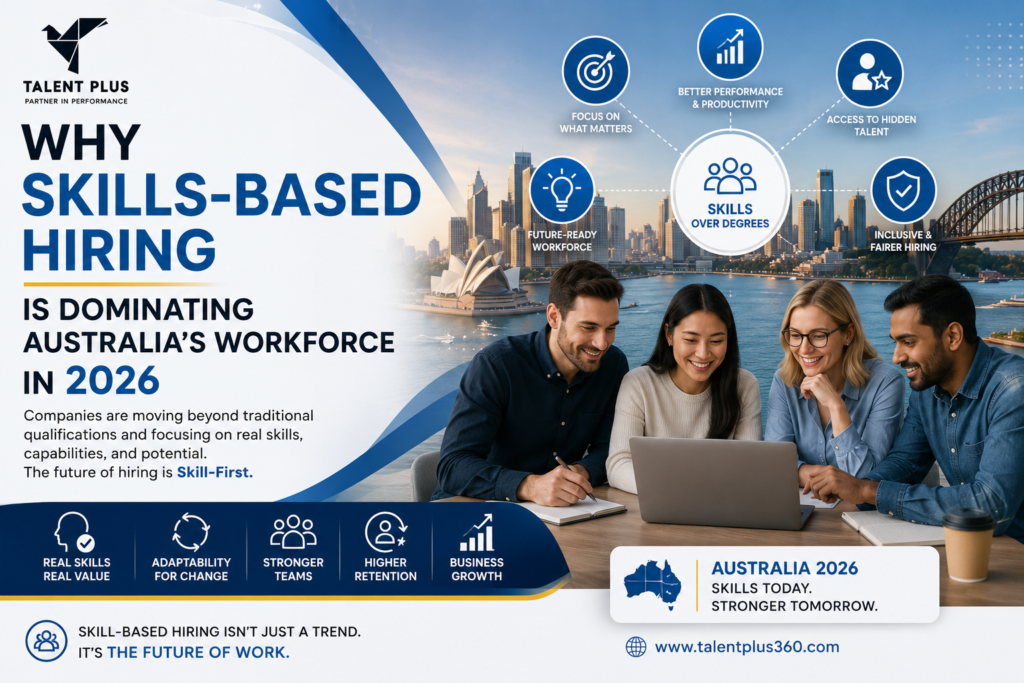
Australia’s workforce landscape is changing faster than ever before. In 2026, businesses are moving away from traditional hiring methods and embracing a more practical and performance-focused approach known as skills-based hiring. Instead of relying only on degrees, job titles, or years of experience, employers are now prioritising real-world skills, adaptability, communication abilities, and problem-solving capabilities. Companies across Australia are realising that success comes from hiring people who can actually perform the job effectively, not just those with impressive resumes. Humanity finally discovered that PowerPoint confidence and actual competence are not always the same thing. Historic breakthrough.
The Shift Towards Skills-Based Recruitment
Skills-based hiring has become one of the most important recruitment trends in Australia because industries are facing ongoing talent shortages and increasing competition for skilled professionals. Businesses now need employees who can contribute immediately, adapt to changing technologies, and support long-term business growth. As a result, organisations are redesigning their recruitment strategies to focus more on capability and practical knowledge.
One of the biggest reasons for the rise of skills-based recruitment in Australia is the growing demand for specialised talent. Industries such as information technology, healthcare, engineering, construction, digital marketing, logistics, customer service, and finance are experiencing major workforce shortages. Employers can no longer afford to reject qualified candidates simply because they do not follow a traditional career path.
Why Australian Companies Are Prioritising Skills
Skills-based hiring helps businesses discover capable professionals who may have gained expertise through hands-on experience, certifications, freelance work, internships, or practical training programs. Many highly skilled candidates are proving their abilities through real-world projects rather than relying only on academic qualifications.
Technology is also playing a major role in transforming modern recruitment. Businesses are increasingly using AI-powered hiring platforms, applicant tracking systems, online assessments, and data-driven recruitment strategies to evaluate candidates based on measurable skills. This shift allows employers to identify applicants who truly fit the requirements of the role instead of relying only on resumes and educational qualifications.
The Impact of Technology on Recruitment
Modern recruitment processes now focus on performance potential, digital capabilities, communication skills, and industry knowledge. Automation, artificial intelligence, cloud computing, and digital transformation are changing the nature of jobs across Australia. Many roles now require employees to continuously learn new systems, software, and technologies.
Employers want individuals who are adaptable, tech-savvy, and willing to upskill regularly. Candidates who demonstrate flexibility and practical expertise often stand out more than those with only formal academic backgrounds. Businesses that fail to adapt to modern recruitment trends risk losing top talent to more forward-thinking organisations.
How Gen Z and Millennials Are Changing Hiring Trends
The influence of Gen Z and Millennials is reshaping Australia’s workforce in 2026. Younger professionals value learning opportunities, workplace flexibility, career development, and meaningful work experiences. They are more focused on gaining practical skills and building versatile careers rather than staying in one role for decades.
Companies that invest in employee growth, training programs, and skill development are becoming more attractive to modern job seekers. Organisations are now creating workplace cultures that support continuous learning, innovation, and employee wellbeing to improve retention and attract skilled professionals.
The Benefits of Skills-Based Hiring
Skills-based hiring is also improving workplace diversity and inclusion. Traditional recruitment methods sometimes create barriers for capable candidates who may not have prestigious degrees or corporate experience. By focusing on skills and performance, businesses can access a larger and more diverse talent pool.
Australian companies are also discovering that skills-based recruitment can reduce hiring mistakes and improve employee retention. Hiring the wrong candidate can be extremely costly for businesses due to lost productivity, recruitment expenses, and training costs. Skills-focused recruitment helps employers assess whether candidates can actually perform the responsibilities of the role before making hiring decisions.
The Rise of Remote and Hybrid Work
The rise of remote and hybrid work models has accelerated the demand for skills-focused recruitment. Employers are no longer limited to hiring candidates within a single location. Businesses can now access talent across Australia and even internationally.
In remote work environments, practical skills, communication abilities, self-management, and digital collaboration skills are becoming more important than traditional office experience. Employees who can work independently while maintaining productivity are highly valued in modern workplaces.
Why Upskilling Matters in 2026
Professional development and upskilling have become critical priorities for businesses in 2026. Companies understand that investing in employee training improves workforce performance and prepares teams for future industry changes. Many Australian organisations are now focusing on continuous learning programs, leadership development, and technical training.
Employers are also placing greater importance on soft skills alongside technical expertise. Communication, leadership, emotional intelligence, teamwork, adaptability, and critical thinking are now considered essential workplace skills. Technical knowledge alone is often not enough in modern business environments.
How Talent Plus 360 Supports Modern Recruitment
At Talent Plus 360, we understand the changing dynamics of Australia’s modern workforce and the growing importance of strategic recruitment solutions. We help businesses identify, attract, and retain skilled professionals who align with organisational goals, workplace culture, and long-term business growth strategies.
Our recruitment and workforce consulting services are designed to support companies navigating today’s competitive employment market. Talent Plus 360 focuses on connecting businesses with professionals who possess both technical expertise and the practical skills needed for success in evolving industries.
The Future of Skills-Based Hiring in Australia
As Australia’s employment market continues evolving, skills-based hiring is becoming more than just a trend. It is now a necessary strategy for businesses that want to remain competitive, innovative, and sustainable in 2026 and beyond.
The future of recruitment in Australia will continue shifting toward capability, adaptability, and continuous learning. Businesses that recognise the value of practical skills and invest in workforce development will gain a major competitive advantage in attracting top talent and achieving long-term success.
In today’s rapidly changing business environment, hiring based on skills is no longer optional. It is becoming the foundation of modern recruitment and workforce success across Australia. Because eventually even corporations had to admit that hiring people who can actually do the work is generally a solid business strategy. Took a few decades and several disastrous hires, but progress is progress.